Scroll Text

.. It shall be the duty of every Citizen of India to defend the Country and render National service when called upon to do so ...... .......

scroll text 2

"That loyalty to the Country becomes ahead of all other loyalties. And this is an absolute loyalty since one can not weight it in terms of what one receives" (Lal Bahadur Shastri) ..... ...... .............. .....
.. "AIPEU-GDS(NFPE)" HAS BEEN JOINED/MERGED/UNIFIED WITH AIGDSU..NOW THE AIPEUGDS(NFPE) IS NOT IN EXISTENCE..HOWEVER THIS BOLG NAME REMAINS THE SAME ..

Tuesday, October 28, 2014

The extract of Rule 152 of Postal Manual Volume V - Production of postal Records for investigation purpose

This is a vital information to our postal comrades to keep their attention in certain cases :


//copy//

Month-long Winter Session to commence on 24th November

New Delhi: Winter session of Parliament will start from November 24 and conclude on December 23 during which a heavy legislative agenda is on the cards. The Cabinet Committee on Parliamentary Affairs headed by Home Minister Rajnath Singh on Monday recommended the dates to the President.

The month-long session will have a total of 22 sittings in which four days have been earmarked for Private Members' business.

A total of 67 bills 59 in Rajya Sabha and eight in Lok Sabha are pending and the government will push for passage of "at least 30 to 35" legislations, a senior minister said.

This will be the second major session since the Narendra Modi Government took over in May.

The long wait for finalisation of seating arrangement in Lok Sabha is expected to be over before the session commences, almost six months after the constitution of the new House.

"We expect the arrangement to be in place before the winter session," said an official at Parliament over the exercise which has dragged on after the declaration of the results of the 16th Lok Sabha polls on May 16.

Average number of sittings in the past five Winter sessions has been 22 and the dates were decided based on precedents, source said.

Finance Minister Arun Jaitley, External Affairs Minister Sushma Swaraj, Law Minister Ravi Shankar Prasad, Chemicals and Fertilisers Minister Anant Kumar and Parliamentary Affairs Minister M Venkaiah Naidu are members of the Committee.

HRD Minister Smriti Irani and Ministers of state for Parliamentary Affairs Prakash Javadekar and Santosh Gangwar are special invitees to the Committee.


 //copy//

Central Trade Unions in India To observe "NATIONAL PROTEST DAY” on 5th December, 2014 -- Press Note


Sunday, October 26, 2014

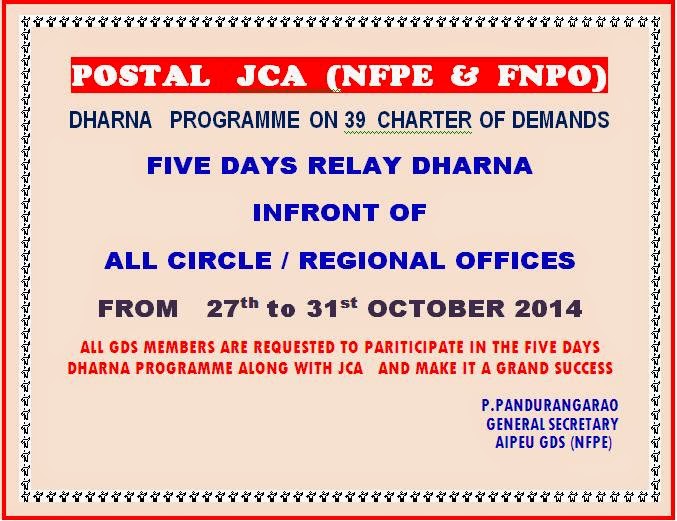
Postal JCA (NFPE & FNPO) Five days Dharna Programme from 27th to 31st October.....


The Rs 2,66,000 crore NREGA boondoggle; for every Rs 5 spent, the poor get Re 1 - NEWS

It is not surprising that any talk of revamping the Mahatma Gandhi National Rural Employment Guarantee Act (NREGA for short) brings forth a deluge of protest from jholawala economists and vested interests. The Left loves government spends in the name of the poor, regardless of corruption and unmindful of actual results.
The Modi government’s proposal to change the spending mix on NREGA from 60:40 (for material and wages) to 51:49 and to focus the scheme on the 200 poorest districts (or 2,500 blocks) has brought forth a open letter from 28 “leading” economists to abandon the effort. “Despite numerous hurdles, the NREGA has achieved significant results. At a relatively small cost (currently 0.3 percent of India's GDP), about 50 million households are getting some employment at NREGA worksites every year. A majority of NREGA workers are women, and close to half are Dalits or Adivasis. A large body of research shows that the NREGA has wide-ranging social benefits, including the creation of productive assets.”

This is, of course, largely bunkum. Nobody needs to deny that some good must have come from spending a massive Rs 2,66,000 crore on NREGA over the last eight years, but even better results could have been achieved by abandoning the charade of providing employment at such huge cost and showering this kind of money from a helicopter in poor areas.

In fact, the evidence is to the contrary: the money is largely going down the drain.
As economists Jagdish Bhagwati and Arvind Panagariya note in a critique of the scheme in The Times of India, NREGA (after taking corruption and leakages into account) essentially spends as much as Rs 248 in order to deliver a net Rs 50 per person per day. In other words, the scheme is highly inefficient even as a poverty alleviation scheme as it takes nearly Rs 5 to deliver Re 1 worth of benefits to the poor. Would not the poor have benefited more from direct cash transfers of a higher amount without hassles and middlemen?
Quite clearly, NREGA is going the same way as the food subsidy scheme, where too just 12 paise out of every rupee spent reaches the right beneficiary .

To make matters worse, state governments are now dragging their feet on implementing the scheme, which promises one member of a household 100 days of employment every year, failing which some kind of unemployment allowance is paid by the states. A report in The Indian Express today (24 October) quotes from the minutes of an internal review of the rural development ministry on the scheme as saying that “states expressed their inability to continue the uninterrupted implementation of MGNREG, given the situation of an overall fund shortage.”

It is not as if the scheme, even now, is working to full potential. As against the 100 days of employment promised, it has seldom managed to provide even 50 mandays on an average per household per year. Mostly it has been in the forties. This year, the figure is down to 31.4 mandays per household till mid-October.

What this suggests is that both demand (for work) and supply (by state governments) is weak – raising questions about the viability and utility of the scheme. It is quite possible that demand for NREGA work may not be as robust as presumed, thanks to the general improvement in rural incomes with the steady and increased fund flows to rural areas, which includes investments in infrastructure and consistently rising minimum support prices (MSPs) for foodgrain.

If NREGA had been a big driver of rural incomes, it should have left its impact on food inflation too, but a Reserve Bank of India study found that MSPs and rising rural wages impacted food inflation more than NREGA wages. If the scheme had actually had that big an impact on rural incomes, one would have thought it would have been a major factor in boosting food prices since only the poorest of the poor opt for work under NREGA. And the poor spend more of their incomes on food than the non-poor.
It is quite clear from all this that NREGA is a costly boondoggle which is not achieving even its core objectives of providing enough work to the poor and building durable assets that can increase productivity. If assets had been built, they should have improved rural productivity and impacted food prices downwards. And if only 31 mandays of work are being provided against the mandated 100, it means either the work is not needed or not being provided.
There are thus three possible remedies now.
First, the centre could offer to transfer the funds allocated to NREGA in the budget as a direct grant to states to spend it on any poverty alleviating scheme that works for them. This would be in keeping with Modi’s federalist thinking.

Second, the funds can be converted to direct income support to the poorest of the poor using the Aadhaar-enabled inclusive banking scheme, the Jan Dhan Yojana. Not only will the money go directly to the poor, but their bank accounts would also start getting used.

Third, the best option would be to use the money to build rural infrastructure and assets in the 200 poorest districts where poverty levels are high. This way the projects will generate real jobs at real wages – and not just pointless work and corruption.

Any which way you look at it, NREGA has been a disaster. The NDA has to rework it to get better bang for the buck.

//firstbiz//

Govt Employee Can’t Seek Promotion After Refusing It: SC

New Delhi: A government employee, whose promotion is canceled owing to his refusal to accept it, cannot ask for it at a later stage, the Supreme Court has said.

The apex court set aside the order of the Madhya Pradesh High Court which had directed the state government to restore the promotion of one of its employees whose promotion was cancelled after he turned down the offer as he did not want to get transferred to some other place.

“As we find that it is the respondent himself who is responsible for cancellation of the promotion order as he did not join the promoted post, the impugned order of the high court is clearly erroneous and against the law,” a bench headed by Justice J Chelameswar said.

The court passed the order on an appeal filed by Madhya Pradesh government challenging the high court order.

The government had submitted that the high court failed to consider that Ramanand Pandey himself sent back the promotion order and continued on his post and approached the court after two years when it cancelled his promotion.

It said that at the time of promotion, Pandey was posted in Bhind district where he remained for almost 15 years and his intention was to stay at that place only.

The apex court, after hearing both sides, quashed the high court order.

“It is clear that he wanted to remain in Bhind district, where he had continued since 1990, as he was ready to go on leave instead of joining the place of transfer. Moreover, for more than two years from the date of cancellation of the order of promotion, the respondent kept totally mum and maintained stoic silence.

“There was not even a semblance of protest as to why his promotion order was cancelled or that he wanted to join the promotion post after the alleged inquiry into the so-called complaint was over. He filed the writ petition on October 24, 2008, i.e. almost two years after cancellation of his promotion order,” it said.
PTI //copy//


HC Sets Aside Centre Order Dismissing Employee On Theft Charge

Mumbai: Terming as “harsh” the Centre’s decision for dismissing a government employee from service for stealing government property, the Bombay High Court has set aside the impugned order and instead lowered the punishment to compulsory retirement from service.

Justices Naresh Patil and BP Colabawalla set aside the July 27, 2010, order of dismissal of Ramchandra Goya Sadhu, who was caught stealing copper rods on May 14, 2010, by the Defense Security Corps Platoon at Tiger Gate here. He was found to have tied the rods around his waist, hiding them inside his clothes.


The court also set aside the March 15, 2013, order of the Central Administrative Tribunal which had upheld his dismissal from service for committing theft of government property.

Instead, the bench ordered that the said employee be slapped with the penalty of compulsory retirement under Rule 40 of CCS (Pension) Rules, 1972, and paid pensionary benefits in accordance with law.

Sadhu had cited a government order wherein four employees who were facing a similar charge of stealing property were not dismissed but given a lesser punishment. Some of them were compulsorily retired from service while others were not given increments for two years.

“Taking into consideration the period of service of the petitioner and his unblemished record in serving his employer, we are of the view that the punishment meted out… namely dismissal from service, was harsh,” the bench noted in its order, which was delivered recently.

“We find that the interest of justice would be met if the order of dismissal of the petitioner is set aside and, instead, the lesser punishment of compulsory retirement from service is imposed,” the bench said.

“We are not for a moment condoning the actions of the petitioner. The charge of theft is indeed a serious one, but looking to the totality of the facts, we feel that in the present case it would be punishment enough if the petitioner is compulsorily retired from service so that he receives pensionary benefits as per the rules,” the judges observed.

The bench said it had taken a sympathetic view in the case only because the petitioner has an unblemished record of 22 years of service and other similarly-placed employees found guilty on theft charges were slapped with penalties lighter than what was meted out to him.
PTI  //copy//

Saturday, October 25, 2014

...........

Some leaders are advocating isolationism to the members of the GDS union.

They are frustrated …..…………. confused …………. demoralized…. antagonized.....

Their methodology and concept  is not clear and transparent ….......

One side demanding departmental status to GDS and other side propagating they would not be affiliated to any federation or becomes members of departmental unions.

This is except provocation to establish the deviation from the unity of GDS and departmental employees and postal working class as well.

If it's so, why such conceptual leadership filed case against the NFPE for GDS affiliation.

The ambiguous strategy of such leaders giving advantage to the anti-GDS forces this time also. Because of their mischievousness and immature behaviour the GDS are facing untold troubles and miserable conditions. 

Dear GDS comrades, don’t caught by the fangs of such leadership…..

By losing all the abilities and to suppress their incapability creating much noise to divert the attention of the structural and strategic  methodology of NFPE.

This is the time for a decision and determination.

LET US MARCH FORWARD WITH NFPE AND CONFEDERATION


Modi and labour reforms: Will be able to satisfy both the industries and unions? - - NEWS

When prime minister Narendra Modi unveiled some steps towards labour reforms, he was responding to long pending demands from business houses and international institutions such as the World Bank; but the critical question is if he has found the fine balance between the needs of the industry and labour.

A highlight of his announcement was the reform of the “inspection raj” in which labour inspectors visited industries according to their will. According to the new arrangement, the process will be automated, which will prevent inspectors from selecting the units to be inspected locally, while inspection reports have to be uploaded within 72 hours.

According to Modi, the old system harassed businesses while the new one will bring in transparency and ease in dealing with the government.

Another point is the announcement of an universal account number for labourers which will allow easy transfer of their Provident Fund accounts. Apparently, about Rs 27, 000 crore is lying idle because of the earlier immovability. "I need to return this money to the poor," Modi said, adding that it was a part of his vision. The reforms will also make paperwork easy - instead of 50 forms, companies will now need to fill only one form, that too online.

At first sight, Modi seems have combined the demands of the industry and welfare of the labourers, but going by the contradictory reactions from both, he certainly has a long way to go.

While ASSOCHAM complimented the "government for initiating the labour law reforms as it will create a conducive environment for growth of Trade and Industry and bring transparency in social security benefits to help workers,” Tapan Sen, General Secretary CITU and Rajya Sabha member said: “it’s only cheating of workers, as while the Government is launching these schemes, simultaneously it is changing the labour laws to push out the labour from their purview”.

Similarly, both FICCI and CII welcomed the measures, while Gurudas Gupta, General Secretary, AITUC, said: “the PM is going in for drastic changes which will ultimately benefit the employees to carry out a hire-and-fire policy and harm working people.

This is being done to give a free hand to the Corporates. This will depress wage levels and shall create a situation for low paid apprentices in place of permanent labour and even contract workers”.

Whether it’s the Modi government or the previous UPA government, labour reforms have mostly been seen as reforms of the labour laws, which the country and states (labour being a concurrent subject) have in plenty. In fact, the UPA had initiated amending many of the labour laws, with a view to helping Indian industries to compete in the global market. In 2005, a tripartite discussion under the then common minimum programme had agreed that “the management would require operational flexibility which includes power to right-size the work force”

The myriad labour laws and the extremely disempowered conditions of labour, a majority of which is in the unorganised sector, makes labour reforms a very complicated endeavour. For instance, writing for the BBC Economist  Kaushik Basu, highlights the case of the Industrial Disputes Act (IDA), 1947, which he says “is a good example of a well-meaning policy that is founded on antiquated economics and a handsome misunderstanding of the way markets function.”

“In fact an amendment made to the IDA in the mid-1980s requires that any firm employing more than 100 workers needs to get permission from the State Government before retrenching workers (and in practice that permission is seldom given), he adds.
His point is that IDA makes firing of workers very hard, which limits the flexibility of free contracting.

From the perspective of industries, and even from the point of view of the prospects of short term contracts for manufacture that companies undertake which require short term workers, it may be true; but from the point of view of labourers, it affects their welfare and security. There may be certainly some justification on tweaking laws to make more trained labour easily available to the industries, without considerable legal hassles, but then the labour also has a right to feel secure. It may also be true that because of the rigidity of some of our laws, companies are unable to expand and innovate. Experts such as Basu point out that labour data from the 1980s show that companies employing more than 100 people have gone down because of the labour laws.

While the labour unions fear a free hire and fire policy, what reformists want is the ability to write different types of contracts - some short term, some long term and an easy regime from the government in terms of controls and supervision. 

Will Modi be able to convince both the businesses and the labour that he stands for growth as well as welfare?

A planning commission working group document that contributed to the 11th Plan (during the UPA) is worth a revisit in the present context, it said: “The UPA rejects the idea of automatic hire and fire. It recognizes that some changes in labour laws may be required but such changes must fully protect the interests of workers and families and must take place after full consultation with trade unions. The UPA will pursue a dialogue with industry and Trade Unions on this issue before coming up with specific proposals. However, labour laws other than the Industrial Disputes Act that creates an Inspector Raj will be re- examined and procedures harmonised and streamlined. 

The UPA government firmly believes that labour-management relations in our country must be marked by consultations, cooperation and consensus, not confrontation. 

Tripartite consultations with Trade Unions and Industry on all proposals concerning them will be actively pursued. Rights and benefits earned by workers, including the right to strike according to law, will not be taken away or curtailed.”

This sounds reasonable and sound in principle. Perhaps, this is the line that the Modi government should also pursue while pushing for reforms.
//copy// PTI